FREE REFERENCE
Printable Military
Time Chart
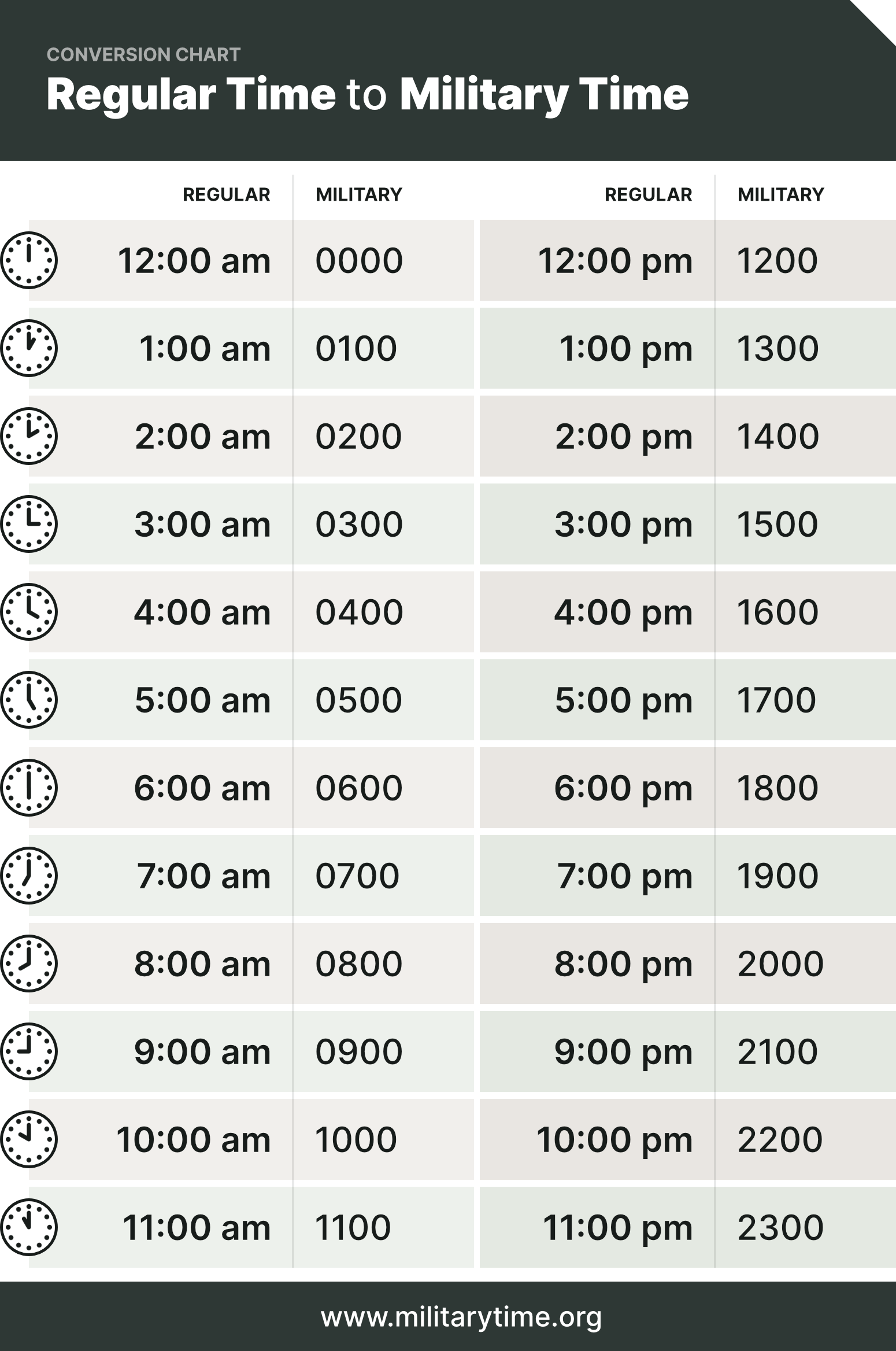
A complete, clean 24-hour conversion table for all hours of the day — military time, standard equivalent, and correct pronunciation. Print and post anywhere you need a fast reference.
Military Time Reference Chart
militarytime.org — All 24 hours with standard equivalent and pronunciation
Conversion rule:
AM (0100–1159): same as regular time
PM (1300–2359): subtract 12
Midnight = 0000 · Noon = 1200
Using This Chart
How to Use the Military Time Reference Chart
This chart is designed for quick two-way lookup. If you know the military time and need the standard equivalent, scan the left column until you find it. If you know the standard time and need the military format, scan the second column.
Military → Standard
Find the four-digit time in the Military column. The Standard Time column shows the 12-hour equivalent. For times 1300–2359, you can also subtract 12 from the hour mentally.
Standard → Military
Find your standard time in the second column. AM hours: prefix with 0 for single-digit hours (9 AM = 0900). PM hours: add 12 to the hour (3 PM = 1500). Noon = 1200. Midnight = 0000.
Where to Post Your Chart
Ideal Locations for a Printed Reference
A printed military time chart is most useful when posted near the locations where staff document times most frequently. These are the most common posting locations across industries that use 24-hour time.
Healthcare
- • Nurses station wall
- • Medication room
- • Break room bulletin board
- • ICU bedside carts
- • Charge nurse desk
Public Safety / Dispatch
- • Dispatch console
- • Watch commander's desk
- • Booking area
- • Fire station day room
- • EMS crew room
Military / Aviation
- • Orderly room bulletin board
- • Operations center wall
- • Flight line break area
- • Training classrooms
- • Personal reference binder
Beyond the Chart
Memorization Tips — Ditch the Chart Faster
A printed chart is a useful crutch while you're learning, but the goal is to internalize military time so you don't need to look anything up. These strategies accelerate fluency.
The subtract-12 shortcut
For all PM hours (1300–2359), subtract 12 from the hour to get the standard time. This is the entire conversion rule for the afternoon and evening. 1600 − 12 = 4:00 PM. 1930 − 12 = 7:30 PM. Practice it 10 times with random times and it becomes automatic.
Anchor on the common times
Memorize: 0800 = 8 AM, 1200 = noon, 1500 = 3 PM, 1700 = 5 PM, 1800 = 6 PM, 2000 = 8 PM, 2100 = 9 PM. These seven anchors cover most common usage. Interpolate from there.
Phone trick
Go to Settings on your phone and switch the clock to 24-hour format. Keep it there for one week. You'll see military time every time you check the time — dozens of exposures per day. Most people report full fluency by day 5. After a week, switch back if you prefer — you'll be able to read military time on sight without thinking about it.
Midnight and noon: the two exceptions
Memorize these two as special cases: midnight is 0000 (not 2400), and noon is 1200. Everything else follows the arithmetic. These two are the only times that don't fit a simple pattern.
Note on Format
This chart shows military time in the no-colon format (1500), which is the correct written form for US military, aviation, and clinical documentation. Some international contexts use the ISO 8601 colon format (15:00) — the times are identical, but the written style differs. If your workplace uses colons, the same conversion logic applies.
DOWNLOADABLE CHART
Military Time Conversion Chart Image
Save this image to your phone for quick reference, or download the high-resolution version to print and post.